Guides
What Is the Difference Between a Cupcake and Muffin?
Cupcakes and muffins may look similar, but they differ in much more than frosting. Discover the differences in ingredients, mixing methods, texture, size, baking cases and nutrition—and find out whether a muffin is really just an unfrosted cupcake.

Rupal Mahajan
25 November 2026 · 13 min read
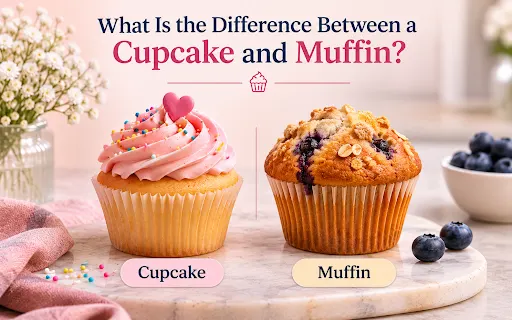
A cupcake and a muffin side by side
Put a chocolate muffin beside a chocolate cupcake with no frosting and the difference may not look obvious. Both are individually portioned bakes, both can be made in the same type of pan, and many recipes use familiar ingredients such as flour, eggs, sugar and fat.
So, what is the difference between a cupcake and muffin?
The short answer is that a cupcake is essentially a small cake, usually made to produce a soft, fine and tender crumb and commonly finished with frosting. A muffin is generally a quick bread, usually mixed more gently to create a denser, coarser crumb and often containing fruit, nuts, grains, chocolate or even savoury ingredients.
Frosting is the easiest visual clue, but it isn't the only difference—and an unfrosted cupcake doesn't suddenly become a muffin.
Here's the comparison at a glance.
| Feature | Cupcake | Muffin |
|---|---|---|
| Basic style | Small cake | Individual quick bread |
| Texture | Fine, soft, light crumb | Denser, coarser crumb |
| Mixing | Often uses cake-making techniques such as creaming | Frequently uses the muffin method |
| Sweetness | Usually sweeter | Can be mildly sweet or savoury |
| Frosting | Common | Usually absent |
| Mix-ins | Possible, but cake remains the focus | Fruit, nuts, grains and other additions are common |
| Top | Usually flatter or gently domed for decorating | Often develops a larger domed top |
| Occasion | Dessert, gifting and celebrations | Breakfast, snack or savoury accompaniment |
| Nutrition | Depends on the recipe and portion | Depends on the recipe and portion |
Let's look at what actually separates the two.
1. Cupcakes and Muffins Use Different Recipe Structures
One of the most important differences between cupcakes and muffins is not how they look after baking but how their recipes are designed.
Cupcakes belong to the cake family. Their recipes are normally formulated around producing a tender, relatively fine crumb. Sugar and fat often play a significant role in both flavour and texture.
Muffins belong more closely to the quick-bread family. They can still contain sugar and fat, but their proportions and preparation often create a sturdier, more substantial crumb.
That means comparing only the ingredient list can be misleading.
A cupcake and a muffin may both contain:
- flour
- eggs
- sugar
- milk
- butter or oil
- baking powder or another raising agent
The real difference often comes down to how much of each ingredient is used and how those ingredients are combined.
Muffin vs Cupcake Ingredients
Typical cupcake recipes tend to emphasise ingredients that create richness, sweetness and tenderness. Depending on the recipe, these may include butter, sugar, eggs, milk, vanilla and cake or plain flour.
Muffin recipes often contain the same basic ingredients but are more likely to incorporate substantial additions such as:
- blueberries or other fruit
- banana
- nuts and seeds
- oats
- bran
- wholemeal flour
- cheese
- vegetables
- chocolate chips
Muffins can also be savoury, whereas cupcakes are overwhelmingly sweet desserts.
This is why ingredients alone cannot always identify the bake. The ratios and preparation method matter too.
2. Difference Between Cupcakes and Muffins Recipe Methods
This is where one of the clearest technical differences appears.
How cupcake batter is commonly mixed
Many cupcakes use techniques also found in full-sized cakes.
A traditional butter cupcake, for example, may begin by creaming butter and sugar together. Beating the mixture incorporates air, after which eggs and dry and liquid ingredients are added according to the recipe.
Other cake methods exist, so not every cupcake follows exactly the same process.
The goal, however, is generally a relatively smooth batter that produces a tender, even crumb.
How muffin batter is commonly mixed
Many muffins use what bakers call the muffin method.
Typically:
- Dry ingredients are mixed together.
- Wet ingredients are mixed separately.
- The two mixtures are combined.
- The batter is mixed only until the ingredients come together.
Overmixing muffin batter can develop too much gluten and produce a tougher result.
The finished batter is often thicker and less perfectly smooth than cupcake batter—and that's completely normal.
This difference in technique helps explain why a cupcake generally feels soft and cake-like while a muffin tends to have a more substantial crumb.
3. Cupcake vs Muffin Texture
Texture is one of the easiest differences to notice once you take a bite.
A cupcake usually has a:
- soft crumb
- fine crumb structure
- light or tender texture
- cake-like mouthfeel
A muffin usually has a:
- denser structure
- larger or coarser crumb
- firmer bite
- more substantial texture
This distinction isn't absolute. A rich muffin can be very tender, while some cakes are deliberately dense.
But when comparing typical recipes, crumb structure is more meaningful than simply asking whether there is frosting on top.
4. Is a Muffin Just an Unfrosted Cupcake?
No.
This is probably the biggest misconception surrounding cupcakes and muffins.
Removing buttercream from a cupcake does not change its recipe, mixing method or crumb. It is still a cupcake—just an unfrosted one.
Likewise, adding icing to the top of a muffin does not necessarily transform it into a cupcake.
Think of frosting as a useful visual clue rather than the technical definition.
What matters more is:
- how the recipe is formulated
- how the batter is mixed
- the resulting crumb
- the intended style of the bake
Cupcakes are commonly frosted because decoration is part of the experience. At The Cupcake Desire, for example, cupcakes are baked to order and hand-frosted with buttercream for Melbourne delivery.
You can explore the bakery's full cupcake collection to see how standard, deluxe, mini and themed cupcakes differ while remaining part of the same basic cake family.
5. Muffin vs Cupcake Size: Which Is Bigger?
There is no universal size rule that makes something a muffin or cupcake.
A bakery-style muffin is often larger than a standard cupcake and may rise considerably above its case, creating the familiar domed "muffin top."
A standard cupcake is often smaller because the portion also needs to accommodate frosting and decoration.
But size alone cannot classify them.
Cupcakes themselves come in several sizes.
The Cupcake Desire, for instance, offers standard cupcakes as well as mini cupcakes in boxes of 24. Its mini cupcakes are deliberately bite-sized for events, morning teas and meetings.
At the opposite end of the scale, its giant cupcakes are designed as centrepieces and can serve around 20 people.
So the answer to "Which is bigger, cupcake or muffin?" is simply:
It depends on the recipe and product.
A typical bakery muffin may be bigger than a standard cupcake, but size does not determine whether something is a muffin or cupcake.
6. Difference Between Muffin and Cupcake Cases
Another common question is whether muffins and cupcakes require different paper cases.
Not necessarily.
Standard cupcakes and muffins are often baked in very similar—or even identical—pan cavities and paper liners. Baktotaal likewise notes that both can be baked in the same type of tin.
The differences you see in bakeries are usually practical rather than rules.
Cupcake cases often:
- fit standard cupcake tins
- sit below the finished frosting
- come in decorative colours or patterns
- form part of the presentation
Muffin cases may:
- be slightly taller
- hold more batter
- use tulip-style paper
- accommodate a larger domed top
Can I use muffin cups for cupcakes?
Usually, yes, provided the case fits the baking pan and you adjust the amount of batter appropriately.
If the muffin case is considerably larger than the cupcake case specified in the recipe, however, baking time and final yield may change.
The reverse is also true: a muffin recipe divided into smaller cupcake-sized cases may bake faster.
So paper cases are mainly a matter of size, presentation and portioning, not what scientifically determines whether the bake is a muffin or cupcake.
7. Muffins Can Be Sweet or Savoury
Cupcakes are essentially desserts.
Chocolate, vanilla, red velvet, salted caramel and similar sweet flavours fit naturally into cupcake recipes, particularly when paired with buttercream, ganache or decorative toppings.
Muffins have a wider flavour range.
Sweet examples include:
- blueberry muffins
- banana muffins
- chocolate-chip muffins
- apple muffins
But muffins can also contain ingredients such as:
- cheese
- spinach
- corn
- herbs
- pumpkin
- zucchini
A savoury cupcake is possible in an experimental sense, but savoury recipes are much more naturally associated with muffins and other quick breads.
8. Cupcakes Are Usually Designed for Decoration and Celebrations
Cupcakes aren't simply small portions of cake for convenience.
Decoration is a major part of their identity.
Depending on the occasion, cupcakes can feature:
- piped buttercream
- edible images
- sprinkles
- chocolate decorations
- coloured frosting
- themed toppers
- event designs
That makes them particularly suitable for birthdays, weddings, workplace events and gifting.
The Cupcake Desire's live range includes occasion boxes for birthdays, weddings, anniversaries, baby celebrations and other events alongside standard and deluxe flavours.
Muffins are generally presented much more simply. A muffin might have a crumb topping, sugar crust, glaze, fruit or nuts on top, but elaborate decoration is less characteristic of the format.
9. Difference Between a Muffin and Cake
The easiest way to understand a cupcake is to compare both products with cake.
Cupcake vs cake
A cupcake is fundamentally a small cake.
The batter can closely resemble or even be the same as a full-sized cake recipe, but it is portioned into individual cups instead of one large cake tin.
Muffin vs cake
A muffin is generally considered a quick bread rather than a miniature cake.
Its preparation and texture tend to be closer to other quick breads, although the boundaries can become blurry with very sweet dessert-style muffins.
So:
Cake → cupcake: largely a difference in format and portion.
Cake → muffin: usually a difference in recipe structure, technique and texture.
10. Cupcake vs Muffin vs Brownie
Cupcakes, muffins and brownies may all be sweet bakery treats, but their structures are different.
| Feature | Cupcake | Muffin | Brownie |
|---|---|---|---|
| Family | Cake | Quick bread | Bar/baked dessert |
| Typical texture | Light and tender | Denser and coarser | Fudgy or chewy |
| Frosting | Common | Uncommon | Optional |
| Shape | Individual round portion | Individual round portion | Usually cut from a tray |
| Sweet/savoury | Sweet | Both | Sweet |
| Typical raising | Cake-style leavening | Baking powder/soda common | Often less aerated |
A brownie generally aims for a dense, rich chocolate structure rather than the light crumb of a cupcake or bread-like crumb of a muffin.
That is also why putting brownie batter into a cupcake case doesn't necessarily make the finished product a cupcake. Shape isn't enough to define the recipe.
11. Are Muffins Healthier Than Cupcakes?
Not automatically.
This is another area where simplistic cupcake-versus-muffin comparisons can be misleading.
Muffins sometimes have a healthier reputation because recipes may contain ingredients such as fruit, oats, bran, nuts or wholemeal flour.
But that does not mean every muffin is nutritionally superior to every cupcake.
A large café-style muffin can contain substantial amounts of:
- sugar
- fat
- chocolate
- toppings
- large portion sizes
Likewise, cupcake recipes vary enormously in their ingredients and size.
The correct comparison must therefore be made between specific products and serving sizes, not between the words "muffin" and "cupcake."
Which is healthier, muffin or cupcake?
There is no universal winner.
A smaller cupcake could contain fewer kilojoules than a very large muffin. A wholegrain fruit muffin may provide more fibre than a frosted cupcake. Another muffin may contain just as much—or more—sugar and fat than a cupcake.
To decide which suits your nutritional needs, compare:
- serving size
- total energy
- added sugar
- saturated fat
- fibre
- protein
- ingredients
rather than assuming "muffin" means healthy.
12. Muffin vs Cupcake Calories
There isn't one reliable number for either product.
Calories—or kilojoules in Australian nutrition labelling—depend on the actual recipe and portion.
A comparison becomes particularly unreliable when someone compares:
- a mini cupcake with a large café muffin
- an unfrosted cupcake with a chocolate-filled muffin
- a standard muffin with a heavily decorated deluxe cupcake
Frosting can increase the energy content of a cupcake, but the much larger portion of some muffins can also significantly affect total calories.
For that reason, we would not give a universal figure such as "muffins have X calories and cupcakes have Y." It would imply a level of precision that doesn't exist without a specific recipe or nutrition panel.
So, What Really Makes a Cupcake Different From a Muffin?
The strongest answer is not simply "cupcakes have frosting."
Instead, think about the entire bake.
A cupcake is generally a miniature cake with a fine, tender crumb, a relatively sweet recipe and a strong association with frosting, decoration and celebrations.
A muffin is generally an individually baked quick bread with a denser, coarser crumb, often prepared using the muffin mixing method and capable of being either sweet or savoury.
There are recipes that blur the boundary, which is exactly why a single visual rule doesn't always work.
If you're looking specifically for small cakes rather than muffins, The Cupcake Desire's Melbourne cupcake collection includes standard, deluxe, mini, vegan, gluten-free and themed options baked to order in Narre Warren.
For questions about ordering, allergens, freshness or delivery, the bakery's cupcake FAQ provides the current information for Melbourne customers.
Frequently Asked Questions
Is a muffin just an unfrosted cupcake?
No. Frosting is only one difference. Muffins and cupcakes commonly differ in ingredient ratios, mixing technique, crumb and intended style. Remove the frosting from a cupcake and it is still an unfrosted cupcake.
Which is healthier, muffin or cupcake?
Neither is automatically healthier. Nutrition depends on the recipe, ingredients and serving size. Some muffins contain whole grains, fruit or nuts, but large sweet muffins can also contain substantial amounts of sugar and fat.
Can I use muffin cups for cupcakes?
Generally, yes, if the cases fit your pan. Larger muffin cases hold more batter, though, so the baking time and recipe yield may need adjusting.
Which is bigger, cupcake or muffin?
A typical bakery muffin is often larger than a standard cupcake, but there is no fixed rule. Cupcakes can also be mini, standard or giant, so size alone does not distinguish the two.
What is the main difference between a cupcake and muffin?
The strongest distinction is in recipe structure and texture. Cupcakes are small cakes designed for a tender, fine crumb, while muffins are generally quick breads with a somewhat denser, coarser crumb. Frosting is common on cupcakes but isn't the defining difference.
Do cupcakes and muffins use the same ingredients?
They can use many of the same basic ingredients, including flour, eggs, sugar, fat and raising agents. However, the proportions, additional ingredients and mixing methods often differ.
Why are muffins denser than cupcakes?
Many muffin recipes use a gentle mixing method in which wet and dry ingredients are combined only until incorporated. Cupcake recipes commonly use cake-making techniques designed to produce a finer, more aerated crumb.
Are muffins always sweet?
No. Muffins can be sweet or savoury. Cheese, vegetables, herbs and corn can all appear in savoury muffin recipes, whereas cupcakes are predominantly sweet desserts.
Final Answer
If you're trying to tell a cupcake from a muffin, don't judge it by frosting alone.
Look at the recipe, mixing method and texture.
Cupcakes belong to the cake family: usually sweeter, softer and finer-crumbed, with decoration often forming an important part of the finished product.
Muffins belong more closely to the quick-bread family: generally denser, more rustic and versatile enough to be either sweet or savoury.
They may share a baking tin, paper case and many ingredients—but they're not simply two names for the same bake.
Tagged